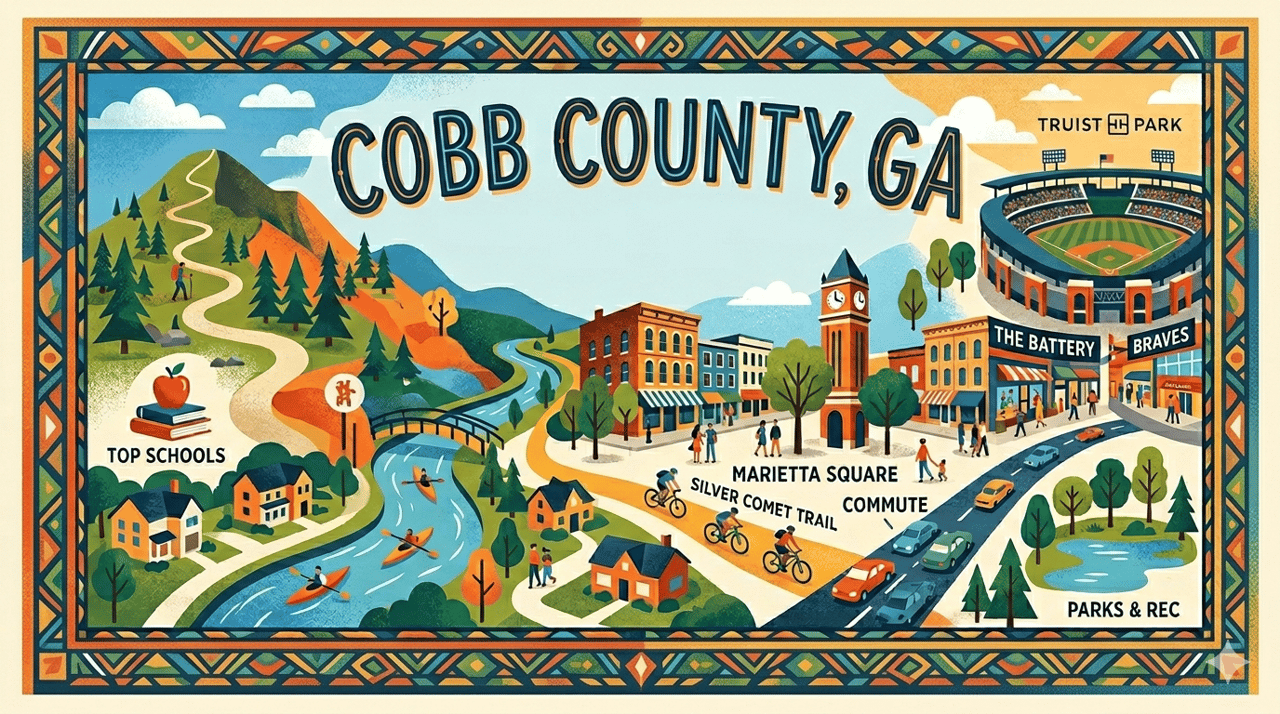
Thinking of Moving to Atlanta? The Honest Truth About Living in Cobb County in 2026
If you are researching the best places to live in the metro Atlanta area, it won't take long for Cobb County to hit your radar. Year after year, it is ranked as a top tier landing spot for transplants and locals alike.
But what is it actually like to live here once the moving trucks unpack? What do people get completely wrong before they arrive?
The biggest misconception people have about Cobb County is that it’s just one giant, uniform suburb. Transplants often expect a sleepy commuter town with nothing but cul-de-sacs and chain restaurants. In reality, Cobb is massive, highly diverse, and fiercely independent—home to over 760,000 residents across distinct zones that feel like completely different cities.
Let's break down the reality of making Cobb County your home.
The Geography & Neighborhoods: Demystifying the "Zones"
Because Cobb is so large, understanding where you fit depends entirely on your lifestyle budget. The county is generally divided into three major personality profiles:
East Cobb vs. West Cobb vs. South Cobb
-
East Cobb: The established powerhouse. Known for its highly coveted school districts, large traditional brick homes, and premium price tag. It lacks a major direct interstate loop, giving it a very residential, safe, and community-centric feel.
-
West Cobb: The sprawling retreat. If you want a larger lot, a newer or custom-built property, and a slightly slower pace near nature, West Cobb (Acworth, Kennesaw, and West Marietta) offers fantastic square footage for your dollar.
-
South Cobb: The revitalization engine. Areas like Smyrna, Mableton, and Austell offer the closest proximity to the actual city of Atlanta. It is heavily favored by young professionals who want urban access without paying Fulton County housing prices.
The Anchor Points: Marietta & Cumberland/Vinings
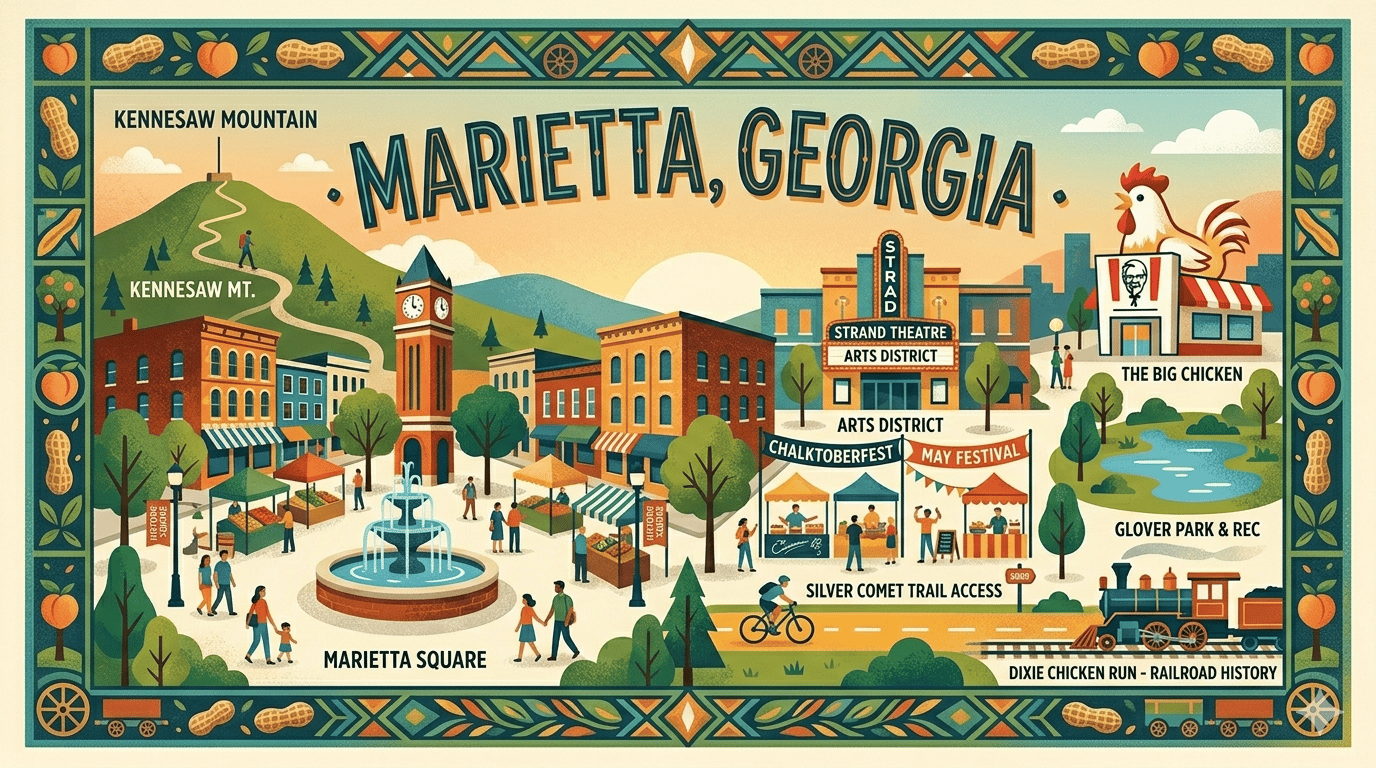
Is Marietta still the heart of Cobb? Absolutely. The historic Marietta Square is the cultural anchor of the county, serving up local boutiques, hyper-local restaurants, a bustling weekend farmers market, and seasonal festivals that keep the county feeling tightly knit.
Meanwhile, on the southeast edge, the Cumberland/Vinings area has exploded into a magnet for young professionals. It bridges the gap between suburban safety and urban energy, offering high-end townhomes, dense walkability, and instant access to the city's job centers.
The Lifestyle & Amenities: More Than Just Cul-de-Sacs
Cobb County's lifestyle profile has transformed over the last decade, evolving far beyond a simple "family-only" suburb.
The Battery and Truist Park Effect
You cannot talk about Cobb without mentioning The Battery Atlanta and Truist Park (home of the Atlanta Braves). Having this massive mixed-use entertainment district right in the county is a massive lifestyle perk. Even when it’s the off-season or the team is on an away stretch, locals flock here for chef-driven dining, bowling, live music at the Roxy, and outdoor drinks. It has successfully anchored an energetic nightlife culture right in the suburbs.
Outdoor Recreation
If you prefer quiet trails over stadium crowds, Cobb holds its own against any county in Georgia.
-
Kennesaw Mountain National Battlefield Park offers miles of hiking trails with sweeping views of the Atlanta skyline.
-
The Silver Comet Trail provides a paved, non-motorized trail that runs all the way from Smyrna to the Alabama state line—a paradise for cyclists and runners.

Schools & Education: The Real Estate Driver
If you are looking at home values, you are looking at the school districts. The Cobb County School District is one of the largest and most decorated in the state, and it continues to act as the primary engine driving local real estate values.
What buyers need to know: Properties zoned for the legendary "Three Popes" high school clusters—Walton, Pope, and Lassiter in East Cobb—command a severe real estate premium. Homes in these clusters hold their value exceptionally well even during shifting markets, often selling faster and seeing significantly higher competitive demand.
If you are looking for excellent schools but need a slightly softer home price, clusters in Harrison (West Cobb) and Hillgrove offer phenomenal educational ratings with slightly lower entry prices per square foot.
The Commute Reality: No Sugarcoating Allowed
Let's talk about the elephant in the room: Atlanta traffic.
If your daily grind requires you to drive into Midtown or Buckhead for work, your average commute from Cobb will realistically clock in around 30 to 35 minutes on a good day—and up to an hour if it rains or there is an accident on the Downtown Connector.
Navigating I-75 and I-285
The intersection of I-75 and I-285 is the main artery of the county. Locals survive by utilizing the I-75 South Metro Express Lanes—reversible toll lanes that let you bypass gridlock for a fee during peak hours. As for "secret routes," locals quickly learn how to use side veins like Powers Ferry Road, Johnson Ferry Road, or Atlanta Road to cut across sections of the county without touching the main highway crawl.
The MARTA Factor
It's a well-known fact: Cobb County famously opted out of joining the MARTA rail expansion decades ago, relying instead on its local CobbLINC bus system. For some buyers who insist on train-to-airport convenience, this is a total dealbreaker. For others, the trade-off for lower county debt and localized control is a net positive.

The 2026 Real Estate Market Snapshot
The real estate landscape has found a stable, balanced rhythm. While we are no longer in the hyper-inflated, blind-bidding-war frenzy of a few years ago, inventory remains tight and demand is steady.
Market Comparison
Cobb County's countywide median list price hovers right around $435,000–$450,000. This sits at a highly competitive sweet spot: notably more affordable than neighboring North Fulton (where towns like Alpharetta and Johns Creek routinely clear $600k+ medians), yet more established than rural-leaning Cherokee County to the north.
What Does Your Budget Buy in Cobb?
| Budget | What It Gets You | Typical Location |
| $400,000 | Well-maintained townhomes, or starter 3-bed split-level resale single-family homes. | South Cobb (Mableton/Austell) or parts of Kennesaw/Acworth. |
| $600,000 | Updated 4-bed traditional single-family homes with a yard, or modern mid-size builds. | West Cobb or mid-Marietta corridors. |
| $800,000+ | Large executive estates, luxury new constructions, or premium placement in top school clusters. | East Cobb (Walton/Pope) or historic Vinings. |
Property Taxes
One of Cobb's greatest selling points is its highly competitive millage rate. Property taxes are lower here than in Fulton or DeKalb counties. Furthermore, Cobb famously offers a school tax exemption for residents aged 62 and older, making it an incredibly popular area for retirees and downsizers looking to permanently lower their fixed overhead.
The Honest Cons: What People Grumble About
No county is perfect. If you move here, the single biggest complaint you will hear from your neighbors is density and rapid growth. Because the county is so popular, empty commercial lots are rapidly transforming into townhome developments and mixed-use spaces. If you hate crowded suburban strip malls or waiting in a long line at the local Trader Joe's on a Sunday afternoon, parts of Central and East Cobb will test your patience.
Additionally, if you buy into a neighborhood expecting historical charm, you might find sections overhyped or overridden by generic suburban retail centers if you don't target specific pockets like the Marietta Square or historic Vinings.

The Verdict: Is Cobb County Right for You?
-
Move to Cobb if: You want a rock-solid investment, top-tier public education for your kids, excellent safety, lower property taxes, and enough local dining and sports entertainment that you rarely have to drive into proper Atlanta for a night out.
-
Look elsewhere if: You want direct, walkable subway transit into the city, absolute isolation/rural quiet, or you prefer the specific trendy, ultra-flat master-planned aesthetic of North Fulton hubs like Alpharetta.
Your Next Step
Every neighborhood in Cobb has a completely different heartbeat. The best way to avoid making a costly mistake is to tour these sub-markets with someone who knows the local block-by-block layout.
Ready to find your match? Connect with our team today for a quick, no-pressure discovery call. We'll map out your commute, your budget, and your lifestyle needs to pinpoint the exact Cobb County pocket that feels like home.
To watch our entire video on this, check it out on YouTube here. Moving to Cobb County, GA? Watch This First
- Thinking about buying or selling in Georgia? Let’s talk!
- Book a quick call
- [email protected]
- Phone: 404-553-4799
- Browse Atlanta homes | Find your home’s value
- Follow on Instagram for local tips, listings & more!
- Greg Goad & Goad Home Partners | Real Broker, LLC | License ID: 373106