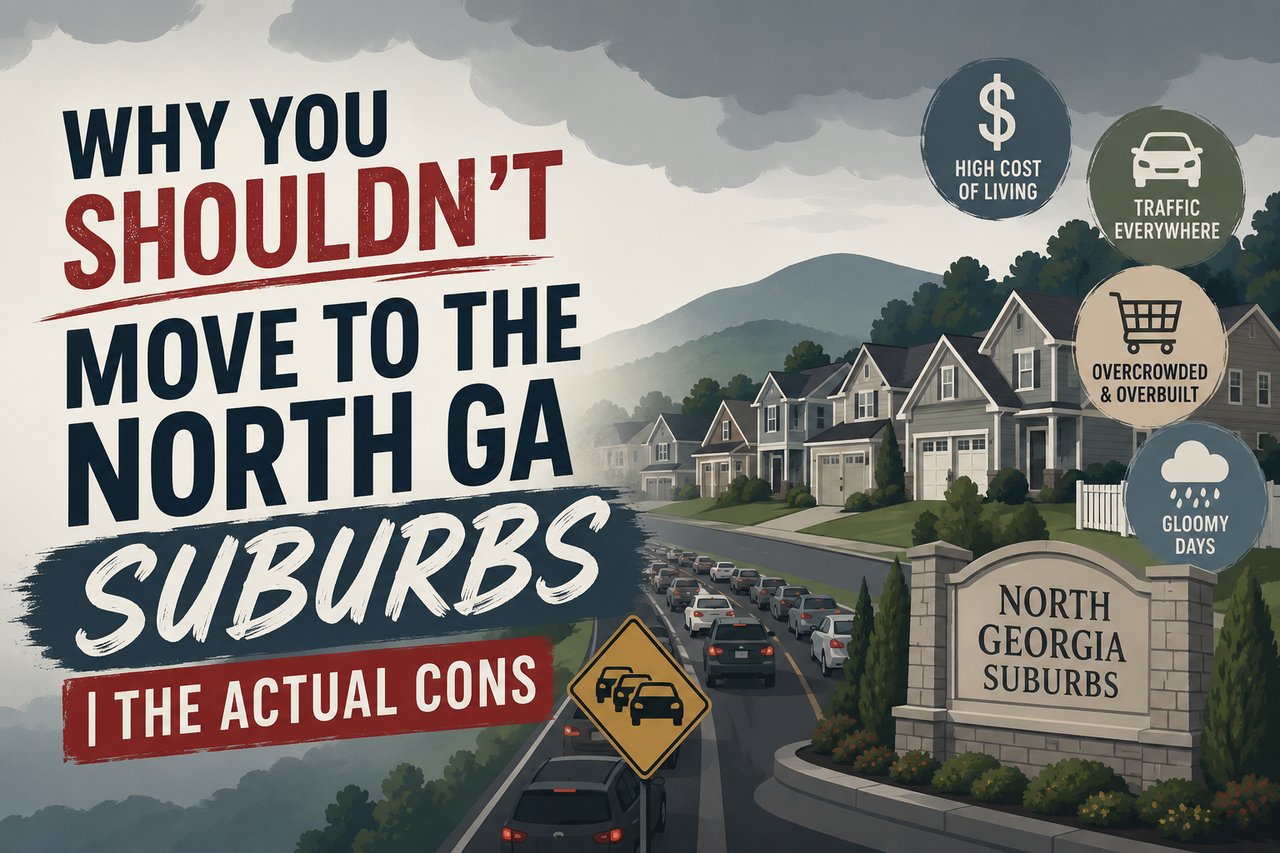

The Real Talk: Why You Shouldn’t Move to the North Georgia Suburbs (and Who It’s Actually Perfect For)
If you’ve been dreaming about packing up and moving to the North Georgia suburbs, you’ve probably seen the highlight reels. You’ve seen the gorgeous pictures of downtown Woodstock, the sweeping views of the Blue Ridge Mountains, and the promises of affordable living.
For years, we’ve helped families plant roots right here in North Georgia. But today, we need to have a real, unfiltered conversation. Why would a local real estate team tell you not to move here? Because we would much rather give you the straight facts now than have you regret your closing day six months from now.
The biggest misconception buyers bring with them when looking at Cherokee County, Canton, Woodstock, or our mountain towns is that it’s still an "undiscovered, dirt-cheap paradise."
The truth? That ship has sailed. Let’s break down the actual cons of living in the North Georgia suburbs in 2026.
1. The Commute Is No Joke (and There Is Zero MARTA)
If you plan to live in Canton, Holly Springs, or Ball Ground while keeping your 9-to-5 job in Midtown or downtown Atlanta, prepare yourself.
The morning rush hour pushing south on I-575 and the evening crawl back north can easily trap you in your car for 60 to 75 minutes each way.
The Peach Pass Reality: You can buy into the toll-lane system (the government-funded reversible lanes), which can shave 15 to 20 minutes off your trip. But even those lanes back up on bad days. Plus, 18-wheelers aren't allowed in them, which makes it feel a bit safer, but it will cost you daily.
No Public Transit: If you are relocating from cities like Chicago, Boston, or New York, erase the word "transit" from your vocabulary. There is no MARTA rail infrastructure up here. The absolute furthest north the train goes is the North Springs Station off the GA-400 corridor, which is well south of Alpharetta and Roswell. Up here, owning a car is 100% non-negotiable.
2. You Will Be Living in Your Car
Beyond the daily work grind, daily logistics require serious windshield time. Unless you are lucky enough to live directly in the historic grid of downtown Woodstock, your neighborhood will not be walkable.
Running out for groceries, dropping the kids off at sports, or grabbing a bite to eat means getting behind the wheel. The good news is that if you find a central hub—like the neighborhoods off Sixes Road—you can be within 5 to 10 minutes of Costco, the Outlet Shoppes of Atlanta, and major brand stores.
Who has cracked the walkability code? Downtown Woodstock is the gold standard here. They have integrated golf-cart zones, a bustling main street, and a highly anticipated major grocery store (Publix) coming to the Woodstock Mill area off Town Lake Parkway. Historic Canton is developing a similar vibe, but for the rest of the suburbs and mountain towns, "walkable daily living" is a myth.
3. The Mountain Towns Are No Longer "Hidden Gems"
Towns like Blue Ridge, Ellijay, and Jasper have completely exploded. If you’re imagining a secluded, quiet escape where you have the trails to yourself, you need to adjust your expectations.
During peak vacation season and weekends, downtown squares are packed, popular hiking trails get backed up, and you can expect a 20-to-30-minute wait just to get a table at local restaurants.
The Market Reset: During the height of the recent real estate boom, everyone tried to buy a mountain cabin to turn into an Airbnb. The market flooded, and buyers who bought at the absolute peak took heavy losses when trying to resell over the last couple of years.
The Good News: Prices have finally stabilized, and appreciation has slowed down to a healthy, normal rate. The small-town charm isn't dead—you just have to know where to look. If you seek out spots like the Cohutta Wilderness Management Area or Mulberry Gap, you can still experience true, quiet outdoor recreation.

4. Home Prices Have Caught Up
A lot of buyers cross county lines assuming Cherokee County is going to offer steep discounts compared to neighboring Cobb or North Fulton. While it's true that your property taxes will be lower (Cherokee features a significantly lower millage rate than Fulton), the home price gap has narrowed fast. The median price point in Cherokee County has climbed to $450,000.
Here is a realistic look at what your budget gets you right now:
The $500,000 Range: You are looking at traditional, highly desirable master-planned swim/tennis HOA communities built around 2007–2008. A prime example is Crestmont off Sixes Road, featuring traditional floor plans on roughly quarter-acre lots.
The $650,000 Range: This opens doors to massive, resort-style communities like BridgeMill (a neighborhood boasting 2,800 homes with a golf course, massive pool, and prices stretching up to $2M) or River Green. At $650k, you’ll find a beautifully kept traditional home with a two-car garage.
The $800,000+ Range: This puts you into premium golf and luxury communities like Woodmont, Harmony on the Lakes, or The Governor’s Preserve near the Canton retail hub. Expect manicured lots, three-car garages, and homes scales at 4,000+ square feet.
5. Once You Go Far North, Infrastructure Thins Out
The moment you travel north of Canton and Jasper toward Ellijay and Blue Ridge, big-box infrastructure thins out. Yes, Blue Ridge has a Walmart and a Home Depot, but if your mountain cabin is 30 minutes outside of the town center, a simple trip for milk turns into an hour-long round-trip expedition.
Furthermore, if you are buying a rural primary residence, you have to do your due diligence on utilities. Many of these homes rely strictly on septic tanks and well water rather than municipal sewer systems. (Pro tip: Always get a sewer scope and a septic inspection before you close! Cellular service can drop completely in the valleys, and high-speed internet isn't a guarantee—though surprisingly, pockets like Mulberry Gap now feature blazing-fast fiber internet!
6. Georgia Summers Are Legit Brutal
If you are moving from the Midwest or Northeast and picturing mild, crisp mountain weather all year long, brace yourself. June through September brings intense Southern heat and heavy humidity.
Does mountain elevation help? Yes. Once you cross into elevations above 2,000 feet, the peaks and valleys catch a distinct breeze, making it noticeably cooler than downtown Atlanta. But let's be real: "Cooler than Atlanta" is still hot. You will be hunting for a swimming hole, a community pool, or a North Georgia waterfall to stay cool all summer long.

7. Growth Is Outpacing the Roads
Cherokee County has expanded rapidly over the last decade. While the Department of Transportation (DOT) is actively implementing traffic circles, widening projects, and parking garages (downtown Woodstock's leadership has done an incredible job managing this), structural updates take time.
The growth is fantastic for your long-term property values and equity, but the immediate trade-off is construction delays and navigating local traffic bottlenecks. The frontier of development is steadily shifting, and the next massive wave of growth is already pushing from Canton up into downtown Ball Ground.
The Verdict: Should You Move Here?
Do NOT move here if: You rely heavily on subways, trains, or urban mass transit. If you want an urban lifestyle where you can walk out your front door and be in the heart of the city in 15 minutes, look into vibrant Atlanta neighborhoods like the Old Fourth Ward, Midtown, or East Atlanta Village instead.
You SHOULD move here if: You have a growing young family, you want access to highly-rated public school systems without paying for private tuition, and you live for outdoor recreation. If you love the idea of spending your weekends playing in the mountains, kayaking the rivers, and coming home to a safe, tight-knit suburban neighborhood with a thriving local economy, North Georgia is unbeatable.
Ready to get the straight facts on your next move?
We don't do fluff, and we don't do high-pressure sales pitches. If you want a real, honest look at the neighborhoods, schools, and homes that fit your lifestyle, reach out to our team directly. Let's set up a quick strategy call and see if North Georgia is the right fit for you!
To watch our entire video on this, check it out on YouTube here. Why You Shouldn't Move to the North GA Suburbs | The Actual Cons
- Thinking about buying or selling in Georgia? Let’s talk!
- Book a quick call
- [email protected]
- Phone: 404-553-4799
- Browse Atlanta homes | Find your home’s value
- Follow on Instagram for local tips, listings & more!
- Greg Goad & Goad Home Partners | Real Broker, LLC | License ID: 373106